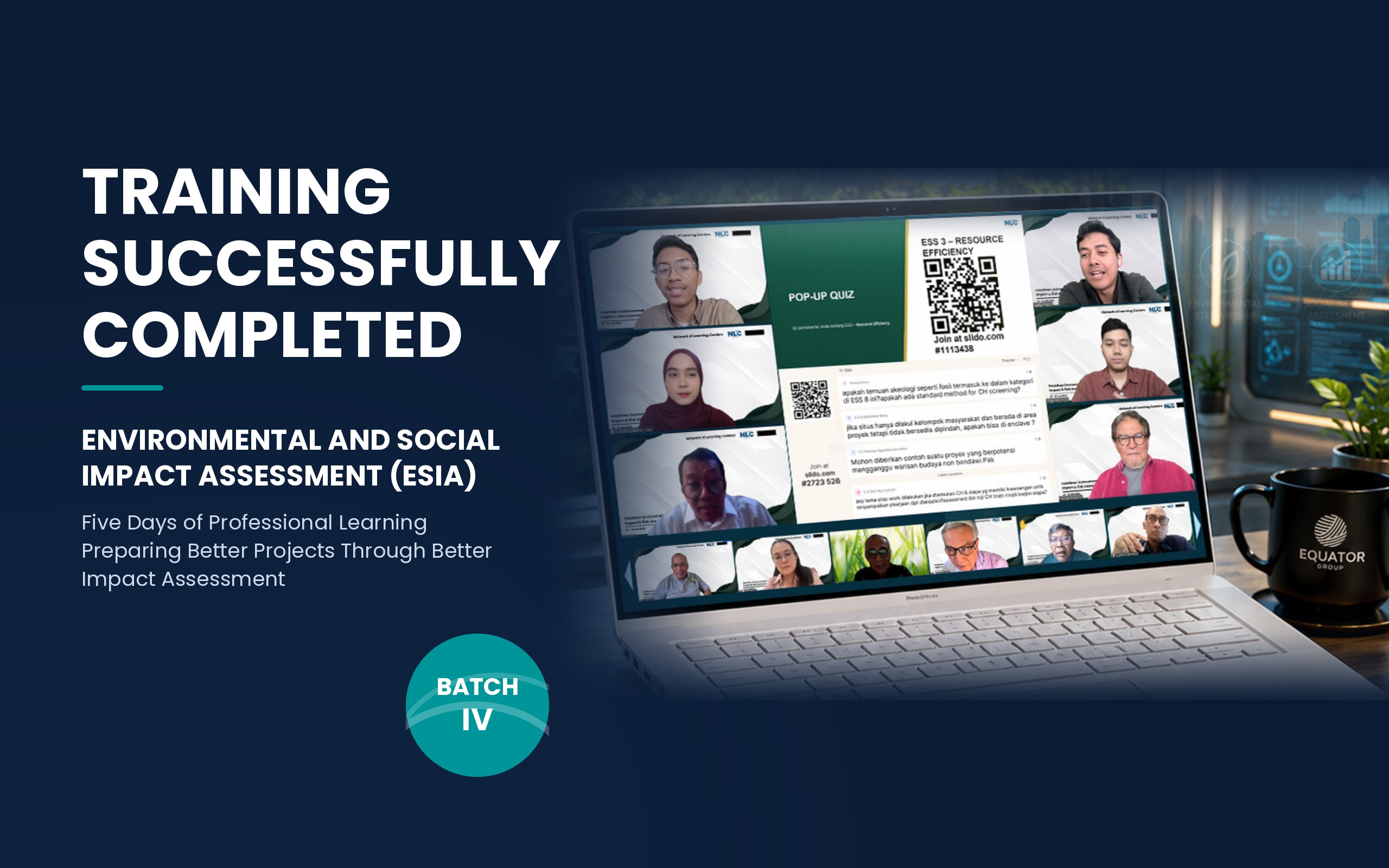
The Network of Learning Centers (NLC) by Equator successfully concluded its fourth batch of Environmental and Social Impact and Risk Assessment (ESIA) training on July 27–31, 2026. The five-day online program brought together 30 participants for a total of 46 instructional hours delivered across 17 sessions, marking the milestone of more than 100 alumni since the ESIA training program was first launched.
The largest portion of the program—15 instructional hours, or nearly one-third of the total training—was dedicated to the ESIA Case Study Exercise. During these sessions, participants examined ESIA documents from several projects in Indonesia, allowing discussions to move beyond theory and into real-world application.
The approach left a strong impression on participants. “This training is different from the ones I attended before. Here, we are encouraged to be independent learners through self-learning beyond the classroom sessions,” said Dini Ayu Lestari of PT KHN, who joined the training from Malinau, North Kalimantan. “The homework, practical exercises, and case studies really helped us learn independently—or rather, pushed us to do so at first—so that we could master topics that were initially unfamiliar.”
The curriculum combined ten environmental and social standards drawn from two international frameworks. Nine standards were based on the World Bank's Environmental and Social Framework (ESF), covering ESS1 through ESS8 and ESS10. Climate change was addressed using ESS9 under the Asian Development Bank (ADB) framework, as the World Bank ESF does not include a dedicated climate standard. Participants were also introduced to the ESF frameworks of the ADB and the Asian Infrastructure Investment Bank (AIIB).
Learning was reinforced through case-based exercises covering land acquisition assessment, Indigenous Peoples protection, habitat classification, and the preparation of key components of ESIA documents. In place of a physical field visit, participants took part in a virtual site visit to the Upper Cisokan Pumped Storage Project, where they observed site conditions, identified potential impacts, and reviewed mitigation measures implemented on the project.
The training featured speakers from diverse professional backgrounds, including practitioners, academics, and representatives of international financing institutions such as ADB, AIIB, and Indonesia Infrastructure Finance (IIF). Each speaker delivered sessions aligned with their area of expertise, covering topics ranging from ESIA preparation, environmental and social impact management, climate change, biodiversity, Indigenous Peoples, occupational health and safety, to stakeholder engagement.
During the closing session, several speakers emphasized the fundamental nature of ESIA. Arifien Sutrisno highlighted that ESIA is a living document that must be continuously updated throughout the project lifecycle, meaning that findings emerging during implementation should be discussed and incorporated into document revisions. Bambang Purwono stressed the importance of distinguishing between risk and impact when developing assessment criteria. “Risk refers to the likelihood of an event occurring, whereas impacts are the consequences that will occur,” he explained.
The organizing committee also announced the 15 most active participants, selected based on punctual attendance, active participation through cameras and discussions, speed and accuracy in quizzes, and completion of all assignments. Participants were also invited to complete the program evaluation form.
Speaking on behalf of the participants, A. Mukhlisin Rony expressed appreciation for the program's intensity while suggesting that the network established during the training should be maintained. “This group should not be closed. It should remain a place where we can exchange information, support one another, and continue networking,” he said. He also described the training as the beginning—not the end—of participants' ESIA capacity-building journey.
Regarding certification, the organizing committee explained that participants who completed the final assessment and achieved a passing grade would receive a certificate of completion, while those who did not pass would receive a certificate of participation. Participants who were unsuccessful would also be given an opportunity to take a remedial assessment.
NLC Chair Rimun Wibowo closed the program by outlining the organization's future development plans. According to him, the interactive learning approach introduced in Batch IV was adapted from a training program he attended in Sydney. “I didn't want what I learned to remain only in my head or in my memory,” he said, explaining why he immediately shared the approach with the team of trainers so it could be further developed together.
Looking ahead, NLC plans to introduce an e-learning system as a prerequisite before participants attend live online sessions, expand its offerings to advanced-level training and other fields such as Land Acquisition and Resettlement Action Plan (LARAP), and explore hybrid learning formats. In the long term, Rimun said, the goal is to develop NLC into a dedicated academy for environmental and social safeguards in Indonesia.
For Rimun, this vision ultimately comes down to nurturing the next generation of professionals. He hopes that today's participants will eventually become trainers themselves—just as Putri Yasmin, an alumna from the early batches, now leads ESIA teams on several projects while also serving as an instructor in the program. “We must continue bringing in younger professionals so that there is no gap in the continuity of environmental and social safeguard expertise in Indonesia,” he said.
Tags